2014 in Perspective
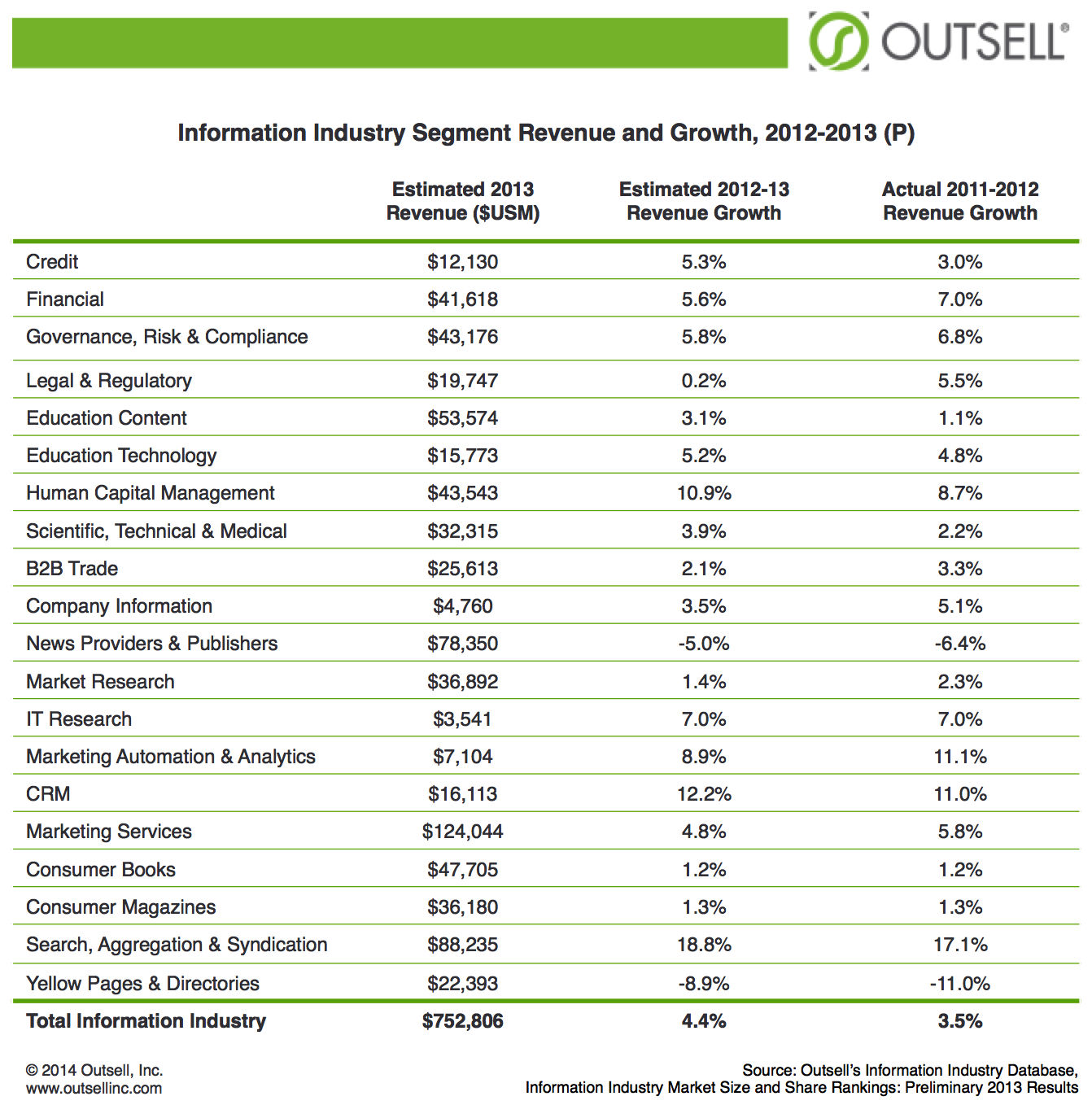
According to Outsell, Inc., the industry grew in aggregate by 4.4% in 2013 to an estimated $753 billion, compared with growth of 3.5% in 2012. The strongest growth shows in Search, Aggregation & Syndication, CRM, Human Capital Management, and Marketing Automation & Analytics. Overall, market segments with a greater emphasis on technology and services are growing much faster than “content-heavy” businesses, most of which are estimated to have grown at about 2.0% or less. Revenues in two of those, News Providers & Publishers and Yellow Pages & Directories, declined once again, by 5.0% and 8.9%, respectively
Information Industry 2013 Revenue and Growth by Segments.
Top 10 Credit Information Providers: Preliminary Estimated 2013 Worldwide Revenues
While the information industry is estimated to have grown at 4.4%, the credit information industry segment grew slightly less at 3.0%.
A Trend that Matters – Convergence is the New Normal
“The information industry is in the midst of significant and visible change. Devices, humans, technologies, value chains, content, and workflows are blending and becoming one human-machine ecosystem. There’s no need for more discussion about the print-to-digital shift or about device adoption – it’s all one now. Using multiple screens at the same time is a commonality and we’re transitioning into the era of wearable devices. With all the opportunity that technology and digital content provide, information businesses are looking for new ways to stay relevant, ahead of competition, and at the forefront of innovation.
“This new wave of convergence also brings real challenges to information companies. Development philosophies are changing, privacy and copyright protection are taking on growing importance, and government regulation is continuing to change.
 “Outsell has studied information companies and the environment they operate in for more than 15 years, and we feel this is an incredibly important time in the history of our industry. The ways companies go to market, produce groundbreaking products and services, and manage people, data, and assets are all changing – right now. This is an exciting time to be an information company, and we look forward to you turning to Outsell when you need research, analysis, and actionable recommendations to navigate your most critical decisions in an industry that never stands still.”
– Anthea C. Stratigos, CEO & Co-Founder, Outsell, Inc.
About Outsell
Outsell, Inc., a co-founder of BIIA, is the world’s only research and advisory firm focused solely on media, information, and technology. We use a time-tested, quality-proven, top-secret blend of data, brains, community, and pizazz to produce extraordinary value for our clients. Elite information industry executives from all over the world look to Outsell for trusted advice, bold insights, and confidential access to exclusive intelligence and decision support. Outsell has your back. You’ll stay more focused, save time, grow revenue in a fast-changing global digital environment, and sleep better at night. Guaranteed.
www.outsellinc.com 
Outsell is a co-founder of BIIA