The amount of new legislation and regulation affecting procurement is creating “a minefield” for the function, an event was told.
 Anna Williams, global procurement director at office construction firm Unispace, said heavy workloads meant it had been “nearly impossible” to get a clear understanding of new and upcoming supply chain due diligence legislation.
Speaking at the eWorld Procurement & Supply conference in London, Williams said: “I tried to do it independently to begin with, using Google searches, trying to look on government websites, and it’s just a minefield. It’s nearly impossible to get a clear answer on what you need to do as an organisation.”
In the session on responsible sourcing she said: “One slip in these types of areas around modern day slavery for example and we’re going to lose a client forever. And the reputational damage that comes with that type of thing is just catastrophic.”
The German Supply Chain Due Diligence Act came into force in January, requiring firms to identify and prevent human rights and environmental impacts in their supply chains or face fines, while an EU-wide supply chain due diligence directive is in the pipeline.
Williams said clients were increasingly looking to see evidence that firms can prove they are acting on issues including diverse suppliers, and have taken steps to prepare for upcoming legislation.
She said: “Supplier diversity is a really hot topic in our industry, and it’s being driven more and more by clients in tenders, and off the back of tender wins we are being monitored very, very heavily on our diverse supply chain.
“And it’s not just about a pie-in-the-sky promise of, ‘We’ll have a 15% diverse supply chain’. We’re finding that clients are actually wanting to understand how we’re going to monitor that and how we’re going to report back to them.”
Harriet Malcolm, global corporate operations coordinator at Unispace, noted that heavy workloads were making it difficult for firms to make time to understand approaching legislation, and Unispace relied on data platform Sedex to brief the company on the steps it needed to take to remain complicit with legislative changes.
“It’s good to get it done externally. Internally, it can be hard to get teams to set aside that time and focus on it when so much is going on, especially when so many teams are trying to balance heavy workloads and trying to balance life balance among it all,” she said.
“Making sure people have that time, the focus by getting someone in and doing it in a shorter time frame than we’d be able to do and balancing it with the other demands on us at the same time, really helped to focus the teams and get it done because it’s a great thing to draw a line under it and establish what’s out there.”
 posted by Juliette Rowsell in Law, Procurement, Risk 2023-03-01
Source: CIPS.ORG/supply-management/news
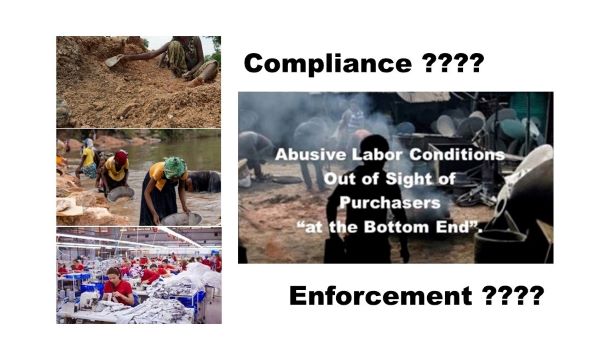
Editorial Opinion: Based on this and other recent articles published on the subject it can be concluded that the law will be difficult to comply with.
The approach taken by the legislator measuring compliance simply based on best effort is not practical. Public Sector Information in many countries, where such abuse is suspected, are inaccurate or non-existent. Many of the operations are out of site hidden from public view. Upon pending inspection the evidence will be removed and later redeployed. Unless local goverments no longer tolerate such practices, compliance will be impossible.
Your editor encourages you to read the recent articles listed below. He also congratulates Anna Williams for taking a tough stand on the issue of impracticality. You may want to read previous articles on this subject:
Microsoft Calls for Coalition to Tackle Labor Issues in Informal Cobalt Mines
Tech Supply Chains Demonstrate Abject Failure on Forced Labour Due Diligence
Practically every Major Car Part Supplier is Car Parts Linked to Forced Labor
Compliance: Which Commodity is most associated with Child Labor
What is in a Name: Lieferantenkettensorgfaltsplichtengesetz